

Reversible Water/LiBr Absorption Heat Pumps: Additives, Thermodynamic Properties, Design and Applications |
|||
|
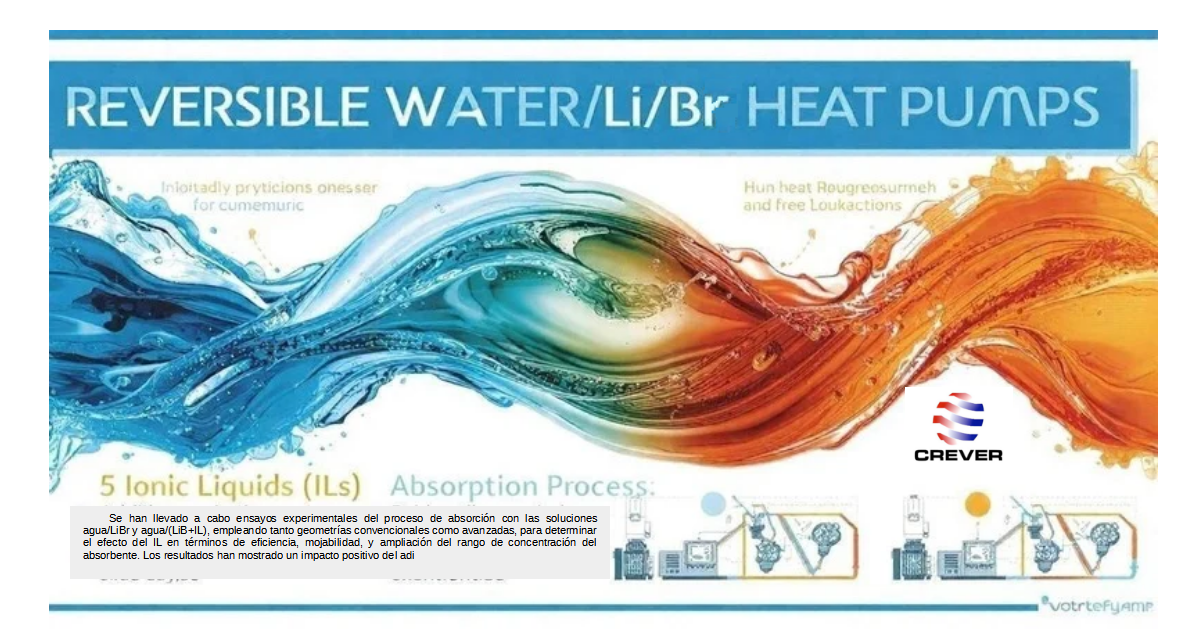
The objective of this project is to contribute to the development of absorption heat pumps (AHPs), based on water/LiBr as the working fluid, capable of reversibly operating in cooling or heating mode using low-temperature heat sources. This objective is achieved by improving the solubility of the working fluid and intensifying the heat and mass transfer processes in the solution circuit's heat exchangers. These advancements will facilitate the integration of AHPs into Smart Energy Communities, thereby accelerating the decarbonization of the building climate control sector. The impact of using five ionic liquids (ILs) as additives in a water/LiBr solution was analyzed. First, the amount of free water was determined using NIR spectroscopy and a multivariate curve resolution method. Second, the solubility of lithium bromide in water was determined in the presence of each ionic liquid at different proportions. Among the five ILs studied, [dmim][Cl] proved to be the most promising, at a ratio of 6/94 with respect to lithium bromide. Furthermore, other thermophysical properties were measured and modeled, and the effect of the ionic liquid on these properties was analyzed. Thermodynamic analysis of the single-effect absorption cycle with water/(LiBr+IL) has shown that the use of IL as an additive allows for a wider operating range of temperature and concentration. This enables efficient operation of the AHPs in both cooling mode, with air heat dissipation in warm climates, and heating mode, providing temperatures between 35°C and 50°C. Experimental tests of the absorption process have been carried out with water/LiBr and water/(LiB+IL) solutions, using both conventional and advanced geometries, to determine the effect of IL in terms of efficiency, wettability, and expansion of the absorbent's concentration range. The results have shown a positive impact of the additive at high concentrations in the absorbent, which are suitable for air-to-air heat dissipation in cooling mode or heat pump operation in heating mode. Finally, the annual performance of a reversible water/LiBr absorption heat pump powered by a district heating network for cooling, heating, and domestic hot water (DHW) was evaluated. The study demonstrated that the proposed system allows for an increase in operating time of up to 63% and a reduction in primary energy consumption of up to 30%, compared to a conventional system. |
|||
 |
 |
R&D&I Projects Research Challenges MINISTERIO DE CIENCIA, INNOVACION Y UNIVERSIDADES Main researchers: Mahmoud Bourouis Chebata and Daniel Salavera Muñoz |
|